
LCV Updating Trading Hours on Liquor Licences: What It Means for Venues
Introduction
Liquor Control Victoria (LCV) has announced a significant update to how trading hours are displayed and applied on liquor licences across Victoria.
While this may appear to be an administrative change, it has real implications for existing licensees and new applications — particularly around late-night trading and outdoor areas.
What Is Changing?
LCV is rolling out a statewide update to liquor licences over the next 6–8 months, starting in April
The update will:
- Clearly reflect the automatic extension of trading hours to 1am (introduced in 2022)
- Align licences with the ordinary trading hours under the Liquor Control Reform Act 1998
- Introduce a new, clearer format for trading hours on licences
These updates will be applied progressively across licence categories.
Why This Matters
On paper, nothing is changing in terms of policy.
But in practice, this will change how licences are interpreted — particularly for venues that have historically operated under older licence wording.
LCV is effectively standardising how trading hours are expressed across all licences.
What Existing Licensees Will See
As licences are updated, venues may notice:
- A revised licence layout
- Trading hours shown as:
- Ordinary hours under the Act
- Extended hours (up to 1am) where applicable
- New special conditions limiting outdoor or external trading areas
This last point is critical.
The Key Issue: Outdoor Areas
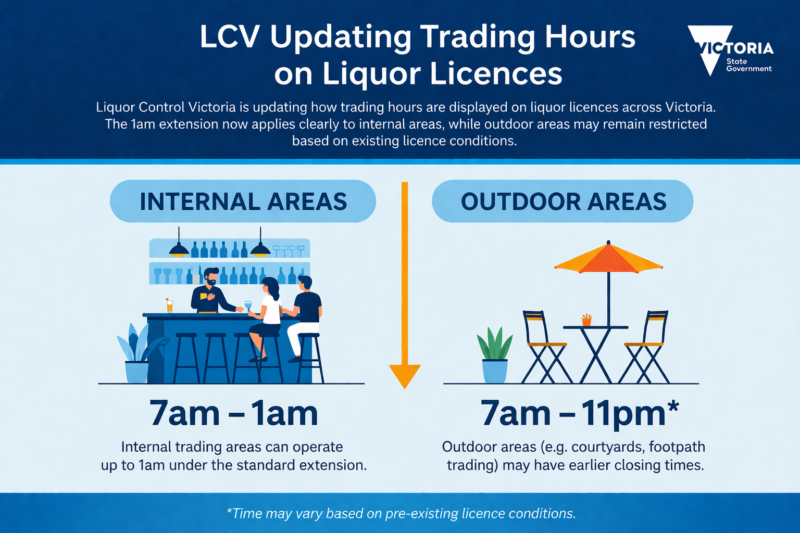
LCV has made it clear that the 1am extension does not automatically apply to all parts of a venue.
For example, where a licence previously restricted an external area to 11pm, that restriction will now be explicitly carried forward as a condition.
As outlined in LCV’s example, a venue may have:
- Internal trading extended to 1am
- External areas still restricted to earlier hours (e.g. 11pm)
This is likely to catch some operators off guard.
What This Means for New Applications
Going forward, all new licences will:
- Default to ordinary trading hours, including the 1am extension where applicable
- Include clear separation between internal and external trading areas
- Potentially include new conditions restricting outdoor trading
This reinforces the importance of getting licence conditions right at application stage.
Practical Implications for Venues
There are a few key takeaways for operators:
- Don’t assume your entire venue can trade to 1am
- Check whether outdoor areas have separate restrictions
- Review your updated licence carefully once issued
- Be cautious when planning late-night activation of external areas
Importantly, licensees will need to download their updated licence once changes are applied
Our View
This change is sensible in terms of consistency — but it will create confusion in the short term.
We expect to see:
- Misinterpretation of trading hours
- Increased queries around outdoor areas
- A need for variations where venues want to extend external trading
For many venues, this may be the first time their licence clearly separates internal and external trading permissions.
Need Help Reviewing Your Licence?
If your licence is updated and you’re unsure what it means for your trading hours, it’s worth getting it reviewed.
Small differences in wording can have a big impact on how your venue can operate.